Public field notes on inference economics, verification economics, and AI
systems engineering. Field Notes #1 to #3 form the May 2026
inference and verification economics sequence; Field Note #4 extends the
archive into AI-system failure analysis; Field Note #9 applies the same
operating frame to cognitive load and human-operable software.
Note on register. Field notes, not peer-reviewed
research; each piece synthesizes published literature and adds an
analytical decomposition. Original measurement is forthcoming. The
original research papers live at /papers.
Software maintainability is usually discussed through proxies: clean code, modularity, complexity scores, review size, architecture style, onboarding time, and documentation quality. These proxies point at one deeper constraint: the acceptance cost of code. This field note reframes cognitive load as the temporary state a maintainer must reconstruct before accepting, rejecting, debugging, resuming, or rolling back a change. It adds claim-status discipline, a concrete before/after checkout-cancellation example, and an Operator Load Budget scoring table for facts, jumps, private mappings, recovery state, evidence gaps, AI-review obligations, and durable schemas.
A daily field note on Ma, Afzal, Eitzinger, and Wellein. Power capping does not bite in memory-bound LLM decode on NVIDIA H200. SM clock locking recovers up to 32% of decode energy. Why the standard energy lever moves the wrong knob, and what that does to the decode-cost term in Cost-correct.
A daily field note on Gao, Zhao, Muhtar et al.'s ROSE. Cooperative elasticity for agentic RL rollouts on idle serving GPUs. Why the rollout-cost term in Cost-correct can be priced at the marginal-of-idle rate, and what that does to the inference-frontier threshold.
A daily field note on Mei, Li, Chen, Pan, Wu, Miao, Jia, and Rashmi's Coral. Cost-efficient multi-LLM serving over heterogeneous cloud GPUs. Why the fragmentation of the LLM market and the heterogeneity of GPU supply make joint allocation the binding cost lever.
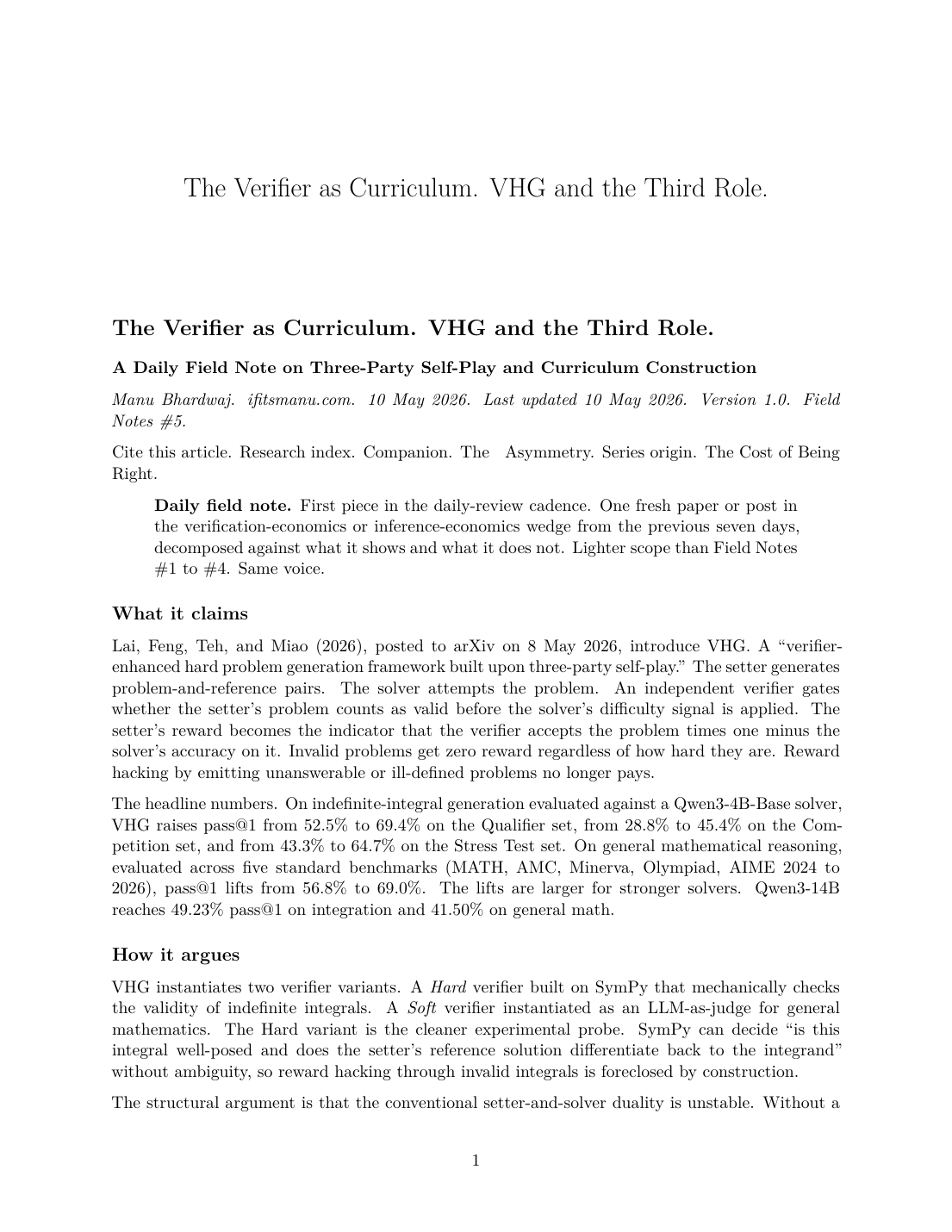
A daily field note on Lai, Feng, Teh, and Miao's VHG. Three-party setter-solver-verifier self-play. Why the verifier's job in the production lifecycle just expanded from two places to three.
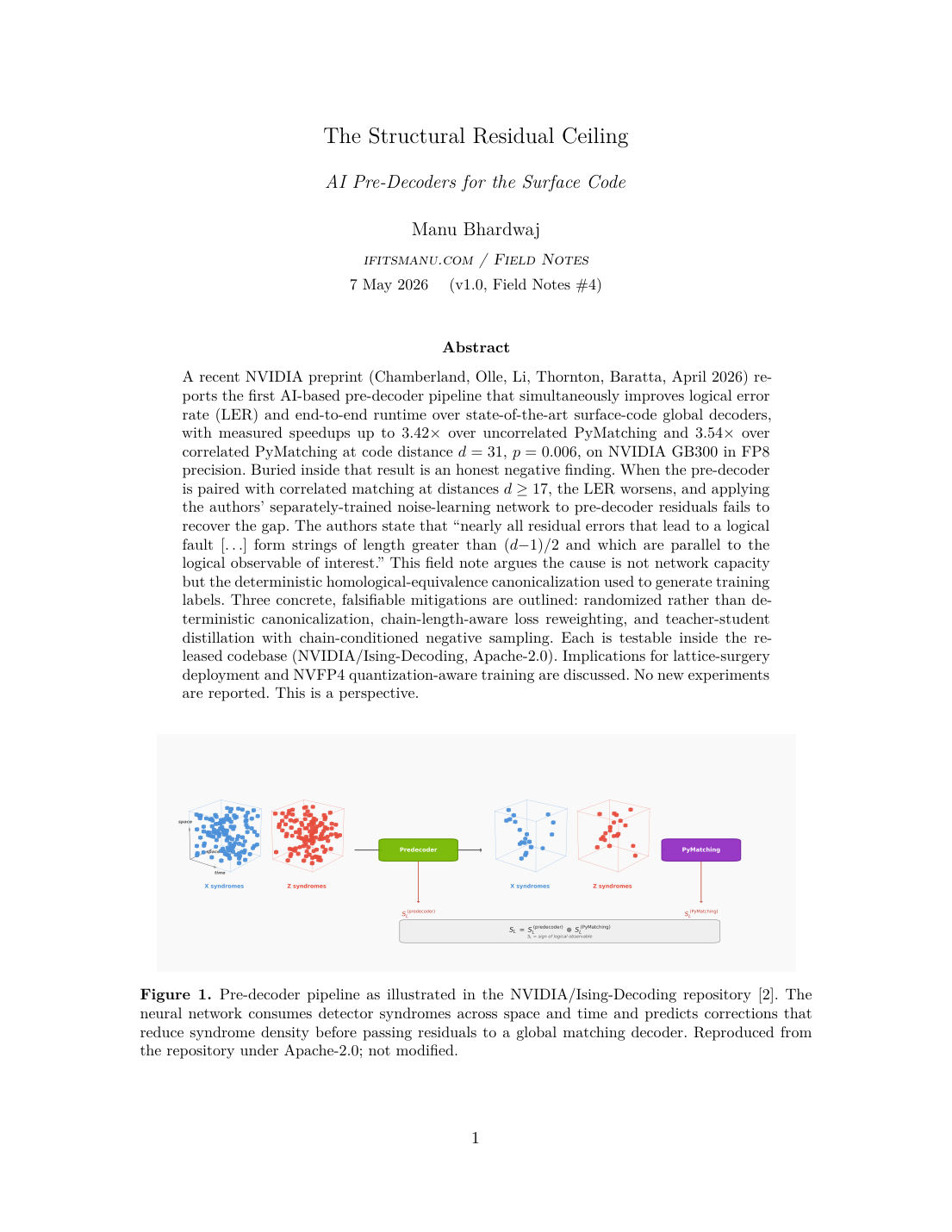
A field note on NVIDIA's Ising-Decoding release. Why the AI pre-decoder paired with correlated PyMatching stops improving logical error rate at distance 17 and above, and what to do about it.