The Cost of Being Right. Verification Economics in 2026.
A Field Note on Reasoning Multipliers, Verifier-Based RL, and the Unit of Account
Manu Bhardwaj. ifitsmanu.com. 6 May 2026. Last updated 6 May 2026. Version 1.0. Field Notes #2.
Download as PDF (10 pages, full math, formal Cost-correct definition + proposition + reference pseudocode). Cite this article. Research index. Previously. The Inference Stack in 2026.
Companion paper. This is the second field note in the series and a sequel to The Inference Stack in 2026. The previous note introduced Verified Capability per Dollar (VCpD) as the operational unit of inference economics and noted, in a footnote, that GPT-5.5 raised public prices in April 2026 for the first time in three years. This note is the explanation. Reasoning is the new dominant cost driver, and verification is the lever that determines whether the cost is worth paying.
Sequel. The third field note in the series, The α Asymmetry. Why Verifiers Can Be Smaller Than Generators. (Field Notes #3), takes the Cost-correct decomposition introduced here and shows analytically that the partial derivative with respect to α dominates the partials with respect to CPM, R, and ρ̄ in the operating regime where production workloads sit. The 7B-verifier-plus-7B-generator pattern of rStar-Math beating o1-preview is what the equation predicts.
Or view the full PDF inline.
TL;DR
The 2022 to 2024 inference cost decline did not reverse. It was masked by a new variable. Reasoning models, RL with verifiable rewards, and verifier-selected best-of-N outputs have shifted the operational unit of inference economics from cost-per-token to cost-per-correct-answer. Recent benchmarks measure up to a 5x token-efficiency dispersion between models with comparable accuracy (Du et al., 2026). On ARC-AGI-2, published cost-per-task figures across frontier configurations span roughly two orders of magnitude at near-equivalent accuracy (ARC Prize, 2025). On the producer side, GPT-5.5 doubled per-token pricing on April 23, 2026, the first OpenAI flagship to raise sticker prices in roughly three years (apidog, 2026). The binding lever in this regime is the verifier. The PDF version of this note develops a Cost-correct extension to VCpD with an explicit verification-accept-rate term, and grounds the framework in the published RL-with-verifiable-rewards literature.
Abstract
Public LLM API prices declined sharply between 2022 and 2024 through four stack-level levers covered in the previous field note. Beginning in late 2024, a fifth dynamic took hold. Reasoning models trained with reinforcement learning on verifiable rewards consume substantially more output tokens per task than their non-reasoning counterparts, and the multiplier is task-conditional and policy-controllable but unbounded above. The MIT FutureTech Price of Progress analysis documents both phenomena simultaneously. Per-benchmark-performance cost falls roughly 5x to 10x per year for frontier models, while the price of running frontier models rises 3x to 18x per year due to bigger models and larger reasoning demands. This note argues that the operational unit of inference economics has therefore shifted from cost-per-token to cost-per-correct-answer, and that the binding lever in the new regime is verification. The verifier may be a process reward model, an RL reward function, a programmatic check, or a self-consistency aggregator. We extend the Verified Capability per Dollar framework to a Cost-correct decomposition with an explicit verification-accept-rate term, ground each component in the published literature, and apply the framework to the GPT-5.5 price action in April 2026 and the EU AI Act high-risk obligations entering force in August 2026.
1. The unit of account is shifting
The previous field note in this series argued that the 2023 to 2026 collapse in public API prices was driven by four compounding stack-level changes. Weight-only quantization with matched mixed-precision kernels. Memory-aware serving runtimes such as PagedAttention and continuous batching. Speculative decoding and related decoding-time parallelism. A hardware market in which GPUs, hyperscaler ASICs, and inference-specialty accelerators competed on delivered tokens per dollar rather than peak TOPS. The note introduced Verified Capability per Dollar (VCpD) as the operational unit of inference economics and noted, in a footnote, that GPT-5.5 raised prices in April 2026 for the first time in three years. That footnote is the starting point for this paper.
The headline trend in price-per-benchmark-performance has not reversed. The MIT FutureTech Price of Progress analysis (Gundlach, Lynch, Mertens, and Thompson, 2025) reports that the price for a given level of benchmark performance has decreased “around 5x to 10x per year” for frontier models on knowledge, reasoning, math, and software engineering benchmarks. In the same paper, a co-existing observation. “The price of running frontier models is rising between 3x to 18x per year due to bigger models and larger reasoning demands.”
Both claims are simultaneously true. They are about different units. Per-benchmark-performance price falls. Per-task-running-cost rises. The reconciliation is the new variable. Reasoning models trained via reinforcement learning to produce extended chains-of-thought before final answers consume substantially more output tokens per task than their non-reasoning predecessors. Three forces compose to make this the dominant cost driver in 2026.
First, reasoning is billed as output tokens. Across every major lab’s public pricing schedule as of May 2026, internally generated chain-of-thought tokens are charged at the standard output rate. OpenAI’s GPT-5.5 doubled per-token rates over GPT-5.4 on April 23, 2026, with input rising from 5.00 per million tokens and output rising from 30.00 per million (apidog, 2026). A reasoning model that emits a 50,000-token chain-of-thought before a 500-token final answer is a 100-to-1 reasoning-to-answer ratio billed entirely at the output rate. The economic signal is that the unit of work has shifted from the answer to the chain.
Second, the multiplier is large and variable. OckBench (Du et al., 2026) reports up to a “5.0x difference in token length” between reasoning models that achieve similar accuracy on the same problem. Token efficiency is now a model-quality dimension as load-bearing as raw accuracy. Two models scoring within a percentage point of each other on the same benchmark can carry costs that differ by half an order of magnitude.
Third, accuracy ceilings are being purchased with unbounded test-time compute. The original test-time compute scaling paper (Snell, Lee, Xu, and Kumar, 2024) established that compute-optimal allocation of inference compute can “improve the efficiency of test-time compute scaling by more than 4x compared to a best-of-N baseline” and can “outperform a 14x larger model” in FLOPs-matched evaluation when the smaller base model has nontrivial success rates. The MCTS-and-process-reward-model paradigm, exemplified by rStar-Math (Guan, Zhang, et al., 2025), improves Qwen2.5-Math-7B from 58.8% to 90.0% on the MATH benchmark and Phi3-mini-3.8B from 41.4% to 86.4%, surpassing o1-preview at small scale, by spending test-time compute on tree-search through verifier-guided reasoning trajectories. The marginal correct answer is now bought with reasoning tokens, and the willingness-to-pay function is steep.
The right unit for inference economics in this regime is therefore not cost-per-token. It is cost-per-correct-answer.
Relation to prior work
The cost-per-correct-answer framing is concurrent with Cost-of-Pass: An Economic Framework for Evaluating Language Models (Erol, El, Suzgun, Yuksekgonul, and Zou, 2026), which formalizes the same metric as “the expected monetary cost of generating a correct solution” and grounds it in Farrell’s theory of productive efficiency. Cost-of-Pass is the metric. Cost-correct, developed in the next sections, is a four-component decomposition of that metric (, the reasoning multiplier , the rollout-or-rejection ratio , and the verifier accept rate ) that exposes which lever is binding. The two frameworks compose. Cost-of-Pass sets the unit of evaluation; Cost-correct names the levers that move it, with singled out as the structurally distinct one (denominator term, hyperbolic in the operating range: a result developed analytically in the companion field note on the α-asymmetry).
2. The reasoning multiplier and where it points
Define R as the reasoning multiplier. The ratio of total billed output tokens, including chain-of-thought plus final answer, to final-answer-only output tokens for the same task. R equals 1 for a non-reasoning model that emits only the answer. R can exceed 100 for a reasoning model that performs extensive search before responding.
Three observations about R, each grounded in measured published data.
R is task-conditional. The same model exhibits very different R across math, code, agentic, and short-form QA. OckBench’s up-to-5x efficiency variance is at fixed task difficulty. Cross-task variance is larger. A reasoning model on a single-fact retrieval task may emit R near 2 to 5. The same model on a multi-step proof or agentic trajectory may emit R well above 50.
R is policy-controllable but not free. Token efficiency is a tunable dimension of training and decoding, not an intrinsic property of the model. There is real engineering surface to compress R. There is also an empirical floor below which accuracy degrades on hard reasoning tasks. The compression is a tradeoff against the accuracy ceiling that test-time compute purchases (Snell et al., 2024).
R by itself does not bind cost-per-correct-answer. R multiplies tokens, but tokens only matter relative to whether they purchase correctness. Two models with R equal to 30 and identical token cost can produce dramatically different end-state economics if one accepts 90% of generated answers as correct on first attempt and the other accepts 30%. The multiplier and the accept rate must be considered together.
This is why the binding constraint in 2026 inference economics is not the multiplier. It is the accept rate. The multiplier is the cost. The accept rate is the value. The lever that controls the accept rate is verification.
The 2022 to 2024 inference cost decline did not reverse. It was masked by a new variable.
3. Verification as the binding lever
Verification, in the relevant sense, is any process by which a generated continuation is evaluated for correctness. By another model. By a programmatic check. By a verifiable reward function during training. By self-consistency across samples. A verifier need not be a heavy model. In many practical deployments it is smaller than the generator.
The verifier-as-economic-lever observation is not new. Cobbe et al. (2021) introduced the GSM8K benchmark together with the case for verifiers. From the abstract. “We propose training verifiers to judge the correctness of model completions. At test time, we generate many candidate solutions and select the one ranked highest by the verifier.” The same paper provides “strong empirical evidence that verification scales more effectively with increased data than a finetuning baseline.” Lightman et al. (2023) strengthened the case with process supervision. A process reward model trained on PRM800K, “the complete dataset of 800,000 step-level human feedback labels,” solves 78% of a representative MATH test subset, beating outcome-supervised baselines. Self-consistency (Wang, Wei, Schuurmans, et al., 2022) is a verifier-free version of the same idea. Sample many reasoning paths. Marginalize over them. The original paper reports a +17.9% lift on GSM8K versus greedy chain-of-thought.
What changed in 2024 to 2026 is that verification became a first-class component of post-training, not just inference. Tulu 3 (Lambert et al., 2024) introduced “a novel method we call Reinforcement Learning with Verifiable Rewards (RLVR)” as a named training procedure. The policy is trained against rewards that are programmatically verifiable, such as whether the math checks out, the code compiles, or the unit test passes. DeepSeek-R1 (DeepSeek-AI, 2025, published in Nature 645:633 to 638) demonstrated that “the reasoning abilities of LLMs can be incentivized through pure reinforcement learning, obviating the need for human-labeled reasoning trajectories,” using verifiable mathematical rewards as the training signal. The OpenAI o1 system card (OpenAI, 2024) confirms the broader pattern. “The o1 model series is trained with large-scale reinforcement learning to reason using chain of thought.” DeepSeekMath (Shao et al., 2024) introduced Group Relative Policy Optimization (GRPO), the variant of PPO that powered most subsequent verifier-based RL work, and reported 51.7% on the MATH benchmark from a 7B base model.
The economic implication is precise. RLVR concentrates capital into verifier construction at training time so that inference-time generation produces a higher accept rate at the same R. rStar-Math’s process preference model (Guan et al., 2025) is the cleanest published example. A 7B base model becomes competitive with o1-preview specifically by being trained against and routed through a verifier. The verifier is small. The verifier is the economic lever.
4. Cost-correct. The decomposition.
The previous note defined Verified Capability per Dollar (VCpD) as a quality-normalized inversion of cost-per-million-tokens, useful when the question is “how much capability does my dollar buy in production.” The framework absorbs reasoning as a multiplier on the cost numerator and verification as a divisor.
Where each term is defined as follows.
CPM1:1 is the blended public-API cost per million tokens used in the previous note. (Pinput + Poutput) / 2.
R is the reasoning multiplier defined in §2. The ratio of total billed output tokens to final-answer-only output tokens for the same task.
ρ̄ is the average rollout-or-rejection ratio under verifier-guided decoding, including best-of-N, MCTS-at-decode, and self-consistency. For a model that simply samples once, ρ̄ equals 0. For a system that samples 16 candidates and verifies, ρ̄ approaches 15.
α(θ, V) is the verification accept rate at quality threshold θ on verifier V. The probability that a generated continuation is accepted as correct by the verifier. For an open-ended chat task with no verifier, α approaches 1 by convention. For a math task with a strict verifier, α may be below 0.1 at first-pass and approach 1 only after rollouts.
The decomposition has three useful properties.
First, the previous note’s VCpD is the special case where R approaches 1, ρ̄ approaches 0, and α approaches 1. Cost-correct extends, not replaces.
Second, all four terms are in principle measurable. CPM is a public price. R is measurable per-task-class via ablation runs against the same prompts on a non-reasoning baseline. ρ̄ is observable through API usage logs. α requires a verifier that one defines. The binding constraint is verifier construction, not measurement.
Third, the engineering surface for cost reduction shifts. The four levers in the previous note act on CPM. The new lever, verification, acts on α. CPM compresses through stack-level engineering, including quantization, kernels, and runtime. α compresses through training-side and inference-side verifier engineering. They are different disciplines.
The operational unit of inference economics has shifted from cost-per-token to cost-per-correct-answer. The binding lever in this regime is the verifier.
5. What verifiers actually look like in production
The verifier-economics framing is more useful when the abstraction has weight. Three production patterns, each with a published reference.
Tree-search with process verifiers. rStar-Math (Guan et al., 2025) runs Monte Carlo Tree Search at decode time, with each candidate continuation scored by a process preference model trained alongside the policy. The system improves Phi3-mini-3.8B’s MATH accuracy from 41.4% to 86.4%, surpassing o1-preview by 0.9 percentage points at small scale. The economic claim is that a small generator plus a small verifier, well-coupled, beats a large monolithic reasoning model on a per-task-cost basis on math.
Search-as-language. Stream of Search (Gandhi, Lee, Grand, et al., 2024) takes a different position. Rather than coupling generator and verifier as separate systems, train a single language model to represent search itself as a flattened token sequence. SoS pretraining “increases search accuracy by 25% over models trained to predict only the optimal search trajectory.” The verifier becomes implicit in the model’s distribution over reasoning trajectories.
Test-time deliberation. Tree of Thoughts (Yao, Yu, Zhao, et al., 2023, NeurIPS 2023) generalizes chain-of-thought to a search tree and reports the canonical result. GPT-4 with chain-of-thought solves 4% of Game of 24 problems. The same model with ToT solves 74%. This is a no-training-time-change result. Pure inference-time deliberation, with self-evaluation acting as the implicit verifier.
These three patterns are not interchangeable. Tree-search-with-process-verifier suits hard-verifiable tasks such as math, formal proof, and code with strict tests. Search-as-language is attractive for tasks where the trajectory itself is part of the output, including planning and agentic. Test-time deliberation works when the model is strong enough to evaluate its own steps reliably and the task admits clean intermediate evaluation. Each has a different Cost-correct profile. The engineering choice is which verifier shape best inverts the binding constraint for a given workload.
6. ARC-AGI-2 and SWE-Bench Pro. The visible price-quality dispersion.
The most legible empirical evidence that the unit of account has shifted is the ARC-AGI-2 leaderboard. The Prize team publishes cost-per-task as a primary axis, not a footnote. As of the December 2025 results analysis (ARC Prize, 2025), published cost-per-task figures across frontier configurations include the following.
| Configuration | Score | Cost per task |
|---|---|---|
| Gemini 3 Pro (baseline) | not specified | $0.81 |
| Claude Opus 4.5 (Thinking, 64k) | 37.6% | $2.20 |
| Gemini 3 Pro with Poetiq refinement | 54% | $31 |
| Claude Opus 4.5 with Poetiq refinement | comparable | ~$60 |
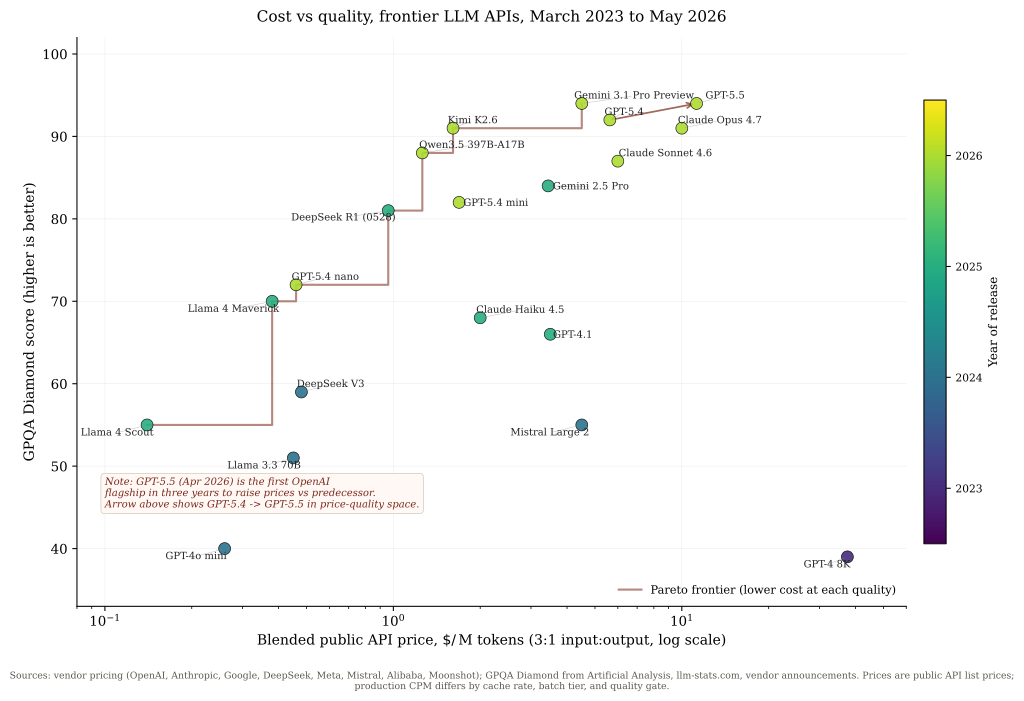
The cheap-to-expensive spread on the same benchmark across frontier configurations exceeds 70x at near-equivalent accuracy. This dispersion is not because some configurations are worse models. It is because verification-conditional rollouts cost more per task and buy more correctness. The leaderboard is, in effect, a published Pareto frontier in cost-per-correct-answer space.
The same pattern is starting to appear in agentic benchmarks. SWE-Bench Pro (Deng et al., 2025), the long-horizon successor to SWE-Bench, contains “1,865 problems sourced from a diverse set of 41 actively maintained repositories.” The benchmark features “long-horizon tasks that may require hours to days for a professional software engineer to complete, often involving patches across multiple files and substantial code modifications.” The trajectory length per task makes per-task-cost the natural reporting metric. Single-figure benchmark percentages without cost numbers are losing decision-relevance for agentic workloads.
The cost-per-correct-answer dispersion on these benchmarks is the empirical surface against which verification economics is measured.
7. The May 2026 pricing landscape
A reading of Cost-correct requires current public pricing for context. The following table summarizes the public API pricing schedule across major reasoning-capable model families as of May 6, 2026, sourced from each provider’s pricing documentation.
| Provider | Model | Input | Output | Source |
|---|---|---|---|---|
| OpenAI | GPT-5.5 (Apr 23 2026) | $5.00 | $30.00 | apidog |
| OpenAI | GPT-5.4 | $2.50 | $15.00 | same |
| Anthropic | Claude Opus 4.7 | $5.00 | $25.00 | Anthropic docs |
| Anthropic | Claude Sonnet 4.6 | $3.00 | $15.00 | same |
| Anthropic | Claude Haiku 4.5 | $1.00 | $5.00 | same |
| DeepSeek | V4-flash | $0.14 | $0.28 | DeepSeek docs |
| DeepSeek | V4-pro (75% promo) | $0.435 | $0.87 | same |
Two structural observations.
The flagship-to-economy spread within a single provider remains roughly two orders of magnitude. Anthropic’s Opus-to-Haiku output spread is 5x. DeepSeek’s V4-flash undercuts Anthropic’s Haiku by 18x on output. The cross-provider spread between an OpenAI flagship and a DeepSeek economy model is more than 100x on output. CPM is no longer a single number. It is a regime selection.
The DeepSeek deepseek-reasoner and deepseek-chat endpoints are deprecated as of late April 2026 in favor of the V4 series. The V4-pro 75% discount is “extended until 2026/05/31 15:59 UTC” per the docs. Pricing in this regime moves on calendar boundaries, not architecture boundaries. Production cost models that assume a static price are out of date by the next quarterly release.
8. The GPT-5.5 reprice as a market signal
The GPT-5.5 price hike on April 23, 2026, with input from 5.00 per million tokens and output from 30.00 per million (apidog, 2026), is the first time in roughly three years that an OpenAI flagship has raised sticker prices versus its predecessor. The headline reaction frames it as a reversal of the inference cost decline. This note’s framework suggests a different reading.
If the operational unit of inference economics has shifted from cost-per-token to cost-per-correct-answer, then a per-token price hike that is more than offset by improved per-task accept rate represents disinflation in the new unit, not inflation. The Cost-correct denominator α grows. If α growth dominates the doubling of CPM, Cost-correct falls.
The hypothesis is therefore that OpenAI is implicitly pricing on a verification-corrected basis. The per-token price reflects the rate-limiting cost of producing answers that pass a stricter internal verification bar. This is a price action consistent with a producer who has interior knowledge of α improvements that the public benchmarks have not yet legibly priced.
The hypothesis is falsifiable. If reproducible third-party measurement shows that GPT-5.5’s α improvement on standardized verifier-bound benchmarks, including RLVR-style math, programmatic code verification, and factuality with retrieval grounding, does not offset the doubled CPM, the price action is not justified by verification economics and is a different signal entirely. The Artificial Analysis Intelligence Index and the ARC-AGI-2 leaderboard are the natural surfaces for this measurement to land.
9. The August 2026 forcing function
A non-economic constraint enters the picture in late summer 2026. The European Union AI Act implementation timeline (artificialintelligenceact.eu, 2024) specifies that “the remainder of the AI Act starts to apply, except Article 6(1)” on August 2, 2026, bringing high-risk AI system obligations into force. General-purpose AI model obligations under Chapter V have applied since August 2, 2025.
Verification economics is regulatory infrastructure for these obligations. The Act requires high-risk system deployers to maintain demonstrable accuracy, transparency, and human-oversight measures, all of which translate, in implementation, to verifier-and-evaluator construction. The Cost-correct unit becomes a compliance unit, not just an engineering one. The α term acquires regulatory weight. Any high-risk deployment must justify accept rates, error analysis, and corrective procedures against a defined verifier specification.
The August 2026 deadline therefore concentrates demand for verification-economics tooling at exactly the moment the producer side, signaled by the GPT-5.5 reprice, is shifting toward the same unit. The two pressures compose. By late 2026, the operational unit of inference economics across both deployment and procurement sides is unlikely to remain cost-per-token.
10. Engineering implications
-
Report cost-per-correct-answer, not cost-per-million-tokens, when communicating production economics. CPM is now a denominator term in a larger formula. Reporting CPM in isolation hides the binding constraint.
-
Specify the verifier alongside the model. Any production claim of “X% accuracy at Y dollars per task” is incomplete without naming the verifier under which X is measured. A verifier specification is a load-bearing artifact, comparable to a benchmark eval suite.
-
Profile reasoning multiplier R per task class. R is task-conditional. Production traffic distributions should be characterized by their (task-class, R) histogram, not a single average. Workload mixing across classes with very different R has dramatic cost implications.
-
Treat the verifier as a deployable artifact. Verifier models deserve the same engineering rigor as generator models. Versioned. Evaluated against held-out sets. Monitored for distributional drift. Economically optimized through smaller size, higher throughput, often quantized, often deployable on-device. The asymmetry is now a feature. A 7B verifier serving a 70B generator is an architecture, not a workaround.
-
Consider RLVR-style training for verifiable workloads. If a workload admits programmatic verification, including math, formal logic, code with tests, and structured outputs, the Cost-correct equation is structurally cheaper to optimize than for open-ended verification. Whether to invest in RLVR training or in inference-time verification depends on workload volume. The crossover is a real engineering decision in 2026.
-
Track α as a first-class production metric. Cache hit rate, latency P99, and tokens-per-second-per-watt belong on the same dashboard as the verifier accept rate at the production quality threshold. A regression in α is a more expensive failure than a CPM spike.
A verifier specification is a load-bearing artifact. Any production claim of "X% accuracy at $Y per task" is incomplete without naming the verifier under which X is measured.
11. Conclusion
The previous note in this series argued that the inference cost story between 2022 and 2024 was a compound curve. Four levers, each amplifying the others, against a hardware market that competed on delivered tokens per dollar. The next eighteen months will be defined by a different compound. Reasoning multiplies the work done per task. Verification multiplies the value extracted per token. The two arithmetic operations sit on different sides of the same fraction.
The lever that worked in 2022 to 2024 was CPM. The lever that works in 2026 is α. A producer that improves α can defend higher CPM, as in GPT-5.5. A deployer that improves α can serve more correctness at the same dollar, as in rStar-Math at the small-model end of the curve (Guan et al., 2025). A regulator that requires α to be measurable can shift the entire market onto the new unit, as the EU AI Act high-risk obligations do in August 2026.
The systems that win the second half of the decade will not produce cheaper tokens. They will produce cheaper correct tokens. The same goal as the previous note, with one new variable made explicit.
References
-
OpenAI. OpenAI o1 System Card. arXiv:2412.16720, 2024 (last revised April 30, 2026).
-
Erdil, E. Inference economics of language models. arXiv:2506.04645, 2025.
-
ARC Prize. ARC Prize 2025 Results Analysis. December 5, 2025.
-
Future of Life Institute. EU AI Act Implementation Timeline. artificialintelligenceact.eu, 2024.
FAQ
What is verification economics?
Verification economics is the framework that makes the verifier the primary cost-and-value lever in 2026 inference. It treats cost-per-correct-answer, not cost-per-token, as the operational unit. The unit equals blended public-API price times the reasoning multiplier R times one plus the rollout ratio ρ̄, divided by the verification accept rate α. The four 2022 to 2024 stack levers (quantization, runtime, decoding parallelism, hardware contestability) act on the price term in the numerator. The new lever, verification, acts on the accept rate in the denominator. Engineering effort in 2026 increasingly compresses the denominator.
Why is the unit of account shifting from cost-per-token to cost-per-correct-answer?
Three reasons compose. First, reasoning chain-of-thought tokens are billed as output tokens at the standard rate, and reasoning models routinely emit chains tens to hundreds of times longer than the final answer. Second, recent benchmarks measure up to a 5x token-efficiency dispersion between models with comparable accuracy (Du et al., 2026), so the per-token unit hides large differences in delivered correctness. Third, the ARC-AGI-2 leaderboard shows that frontier configurations span roughly two orders of magnitude in cost per task at near-equivalent accuracy (ARC Prize, 2025), making cost-per-correct-answer the only metric that distinguishes them.
Why is GPT-5.5’s price hike consistent with falling cost-per-correct-answer?
If the verification accept rate α improves enough that Cost-correct falls despite a doubled CPM, the per-token reprice is disinflation in the new unit, not inflation. The doubled price reflects the rate-limiting cost of producing answers that pass a stricter internal verification bar. The hypothesis is falsifiable. If GPT-5.5’s α improvement on standardized verifier-bound benchmarks does not offset the doubled CPM, the price action is not justified by verification economics. The Artificial Analysis Intelligence Index and the ARC-AGI-2 leaderboard are the surfaces where this measurement will land.
Where does RLVR fit in this framework?
Reinforcement Learning with Verifiable Rewards, as named in Tulu 3 (Lambert et al., 2024) and exemplified in DeepSeek-R1 (DeepSeek-AI, 2025), concentrates capital into verifier construction at training time so that inference-time generation produces a higher accept rate at the same reasoning multiplier. RLVR is the training-side complement to inference-time verification methods such as best-of-N, self-consistency, and Monte Carlo Tree Search with process reward models. The two sides are interchangeable in principle and complementary in production. The crossover point depends on workload volume.
What does a small verifier serving a large generator look like?
The cleanest published example is rStar-Math (Guan et al., 2025). A 7B base model becomes competitive with o1-preview on the MATH benchmark by being trained against and routed through a process preference model that is similarly small. The economic claim is that a small generator plus a small verifier, well-coupled, beats a large monolithic reasoning model on a per-task-cost basis on math. This is the canonical architectural pattern that verification economics rewards. In production, small quantized verifiers can be deployed on-device or close to the user, while generation may remain in the cloud.
Why does the EU AI Act matter for verification economics?
The remainder of the EU AI Act applies on August 2, 2026, except Article 6(1) (artificialintelligenceact.eu, 2024). High-risk system deployers must maintain demonstrable accuracy, transparency, and human-oversight measures. In implementation, these translate to verifier-and-evaluator construction. The α term in Cost-correct therefore acquires regulatory weight in addition to engineering weight, and the cost-per-correct-answer unit becomes a compliance unit. The Act forces verification onto every regulated deployer at exactly the moment the producer side is signaling the same shift.
Cite this article
@misc{bhardwaj2026verification,
  author = {Bhardwaj, Manu},
  title  = {The Cost of Being Right: Verification Economics in 2026},
  year   = {2026},
  month  = {May},
  url    = {https://ifitsmanu.com/papers/the-cost-of-being-right},
  note   = {Field note. Field Notes \#2. Version 1.0.}
}Bhardwaj, M. (2026, May). The cost of being right: Verification economics in 2026. ifitsmanu.com. https://ifitsmanu.com/papers/the-cost-of-being-rightBhardwaj, Manu. "The Cost of Being Right: Verification Economics in 2026." ifitsmanu.com, May 2026. https://ifitsmanu.com/papers/the-cost-of-being-right.M. Bhardwaj, "The Cost of Being Right: Verification Economics in 2026," ifitsmanu.com, May 2026. [Online]. Available: https://ifitsmanu.com/papers/the-cost-of-being-rightPreviously. The Inference Stack in 2026. Research index. Home.